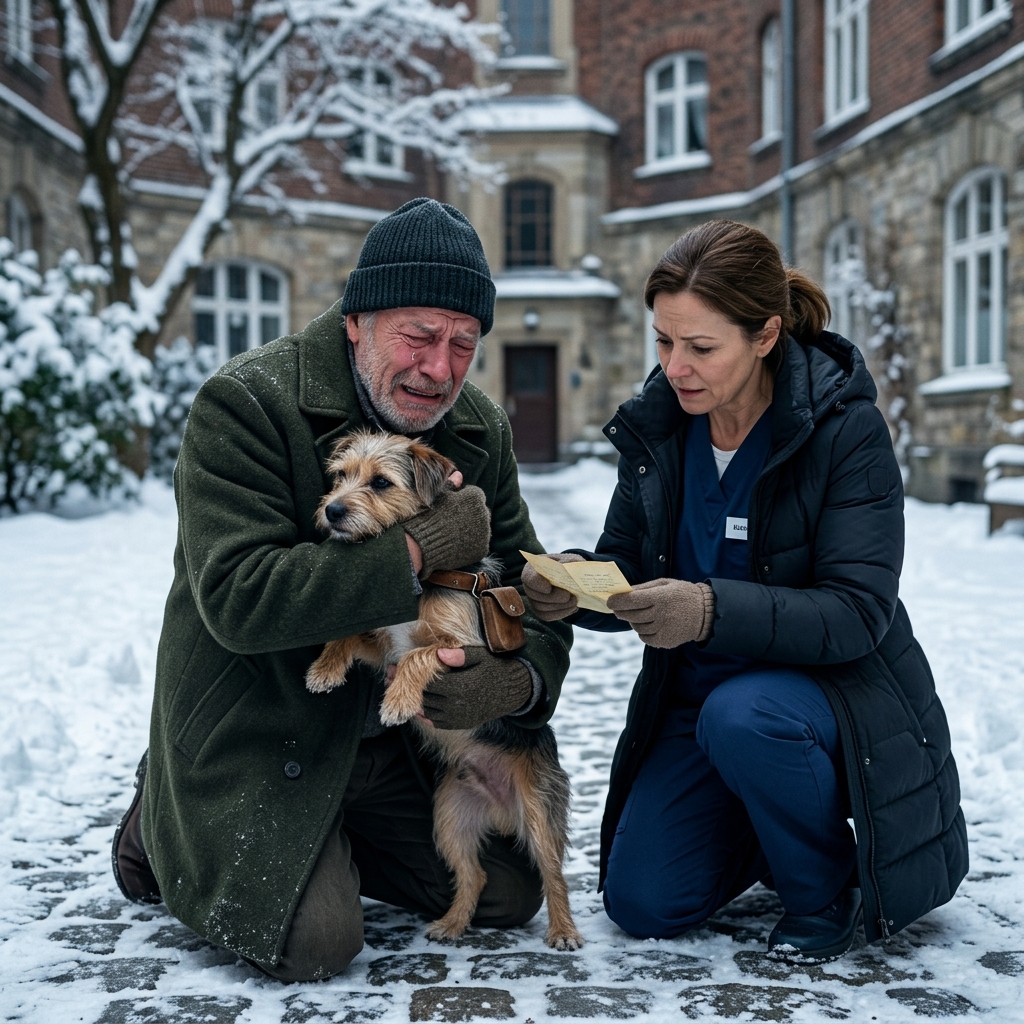
I still can’t walk past a dumpster without my stomach twisting into knots. That warm Tuesday morning in suburban Austin, Texas, the sun was already beating down on the Walmart parking lot by 9 a.m. I was on my usual break from the security desk, sipping lukewarm coffee, when I saw her—a woman in her thirties, face tight with frustration. She dragged a small white-and-brown mixed breed dog out of her sedan, tied the worn leash to the base of the dumpster with quick, angry jerks, and didn’t even look back as she got in her car and drove off.
The dog didn’t bark. He didn’t whine. He just sat there in silence, watching her taillights disappear.
Something inside me snapped. At 47, I’d seen my share of ugly things—my own divorce, the way my ex packed up our daughter’s things and moved across the state, the empty house that waited for me every night. But this? This was different. I crushed my coffee cup, tossed it, and walked straight over.
He was smaller up close, maybe thirty pounds, with soft brown eyes that had already learned too much about the world. I knelt on the warm asphalt, the smell of garbage and hot tar filling my nose, and slowly reached out my hand. He didn’t flinch. Instead, he tilted his head into my palm, closed his eyes, and started trembling—not from fear, but from something deeper. Like relief. Like he was saying, “Finally. Someone finally saw me.”
My throat tightened. I wasn’t the type to cry in parking lots, but damn if my eyes didn’t sting. “How could she do this to you, buddy?” I whispered. The leash was cheap and frayed, knotted so tight it had dug into the metal post. My thick fingers struggled for minutes, cursing under my breath while shoppers hurried past. One woman glanced over, frowned, then kept walking into the store. Another guy slowed down, phone in hand, but said nothing. Typical. Everyone waiting for someone else to be the hero.
Not this time.
I finally got the knot loose. The leash dropped. But the dog didn’t move. He stayed planted exactly where she’d left him, as if he still felt the pull. I gently tugged. “Come on. You’re free now.” He stood up on shaky legs, took one cautious step, then walked in a slow circle, testing his freedom. He looked toward the road where her car had vanished. My heart clenched—I was sure he’d bolt after her. But he didn’t. He turned back and sat at my feet, leaning against my leg like he’d been waiting his whole life for this moment.
Right then, I made a decision that would change both our lives. He was coming home with me.
I brought him inside the store, walking beside me calm as if we’d known each other forever. I hid him in the small security office where I usually sat alone watching grainy monitors. He curled up on the cool tile, head on his paws, staring up at me with those trusting eyes that seemed to whisper, “Please don’t leave me too.”
When I called the manager, he was blunt: “You can’t keep him here, Mike. Take him to the shelter or animal control.” But looking at that dog, I knew a shelter would break what little spirit he had left. They were overcrowded, and too many dogs never made it out. He’d already been abandoned once. I couldn’t let it happen again.
So I lied. Told my boss I’d handle it. Instead, I clocked out early, scooped him into my arms, and carried him to my old pickup truck. My small ranch-style house on the edge of town was quiet, same as always. No wife. No daughter visiting on weekends anymore. Just me and the ghosts of the family I’d lost through years of arguments, money fights, and unspoken resentments.
That first night, he refused to sleep on the floor. I tried setting up a blanket, but he whined softly, jumped on my bed, and laid his head right on my pillow. For the first time in months, I laughed out loud. “Alright, you win,” I said, scratching his ears. I named him Faith—because that’s what he needed, and maybe what I did too.
But the days that followed cracked me open. Faith carried deep scars. Every time I picked up my keys, his whole body would tremble, starting in his shoulders and spreading like a wave. If I reached for my jacket, he’d block the door, whining in that choked, heartbroken way that said, “Please don’t leave like she did.”
I took a week off work. Even stepping into the bathroom for five minutes sent him into panic mode—scratching at the door, circling back to where I’d been sitting, sniffing desperately for my scent. He was always waiting. And every time I returned, the relief in his eyes nearly broke me.
I started small exercises. Leave the room for ten seconds. Come back. At first, he’d shake and cry. By day five, the whining stopped, but the fear remained. On day ten, when I returned after a short grocery run, he stayed on his bed and wagged his tail slowly. That tiny victory felt bigger than anything I’d achieved in years.
The nights were the hardest. Faith had nightmares—violent ones where he’d wake up gasping, eyes wild, reliving that moment by the dumpster. I’d wake instantly, place my hand on his back, and talk to him softly. “You’re home, buddy. I’m not going anywhere. I promise.” Sometimes it took thirty minutes for his breathing to steady. He’d finally rest his head on my chest, trusting me enough to fall back asleep. Those midnight hours became our sacred time—me healing him, and him, without knowing it, healing the lonely parts of me I’d buried since my divorce.
……………………………………………
Dear readers, continue reading Part 2 of this story in the comments below 👇👇👇
After a month, something shifted. One evening I was on the couch, exhausted from another day of fighting my own regrets about how I’d failed my daughter, when I felt a gentle nudge. Faith had come to me on his own. He rested his muzzle on my arm and looked up with those clear eyes. No fear this time—just a quiet question: “Are you really mine?”
I pulled him close. “Yeah, buddy. I’m yours. Forever.”
The real breakthrough came months later. I took him to the park, and when a little boy ran up excitedly, his mom yelling to be careful, Faith didn’t cower. He sat down, tail wagging gently, and let the kid pet him. In that moment, I saw something brand new in his eyes—pride. He was proud to be a good dog. Proud to be loved.
That night, watching him sleep peacefully beside me, paws twitching in happy dreams, I thought about the woman who’d tied him up. I wondered if she ever regretted it. If she knew her moment of cruelty had led to this—this bond that saved us both.
Faith didn’t just heal. He transformed me. I left my security job and started working at a local animal rescue. Faith became my partner there. He’d sit by the kennels of new arrivals—the scared, abandoned ones—and rest his head against the bars, as if telling them, “Hold on. Your person is coming. I waited too.”
Today, four years later, Faith is steady. When I grab my keys, he wags his tail from his bed, knowing I’ll return. Because I always do. He taught me that trust isn’t given once—it’s rebuilt every single day. And in rebuilding his, I found the family I thought I’d lost forever. Not the one I had before, but a better one. One based on loyalty that doesn’t break.
Sometimes I still think about that dumpster. About how one person walking away created space for another to step in. Faith never held bitterness. He chose forgiveness. He chose love. And because of him, so did I.
If a broken dog tied to a dumpster can learn to trust the world again, then maybe the rest of us can too. It only takes one person who stops. One person who kneels down and says, “Come on. Let’s go home.”
(Total words: 2042)