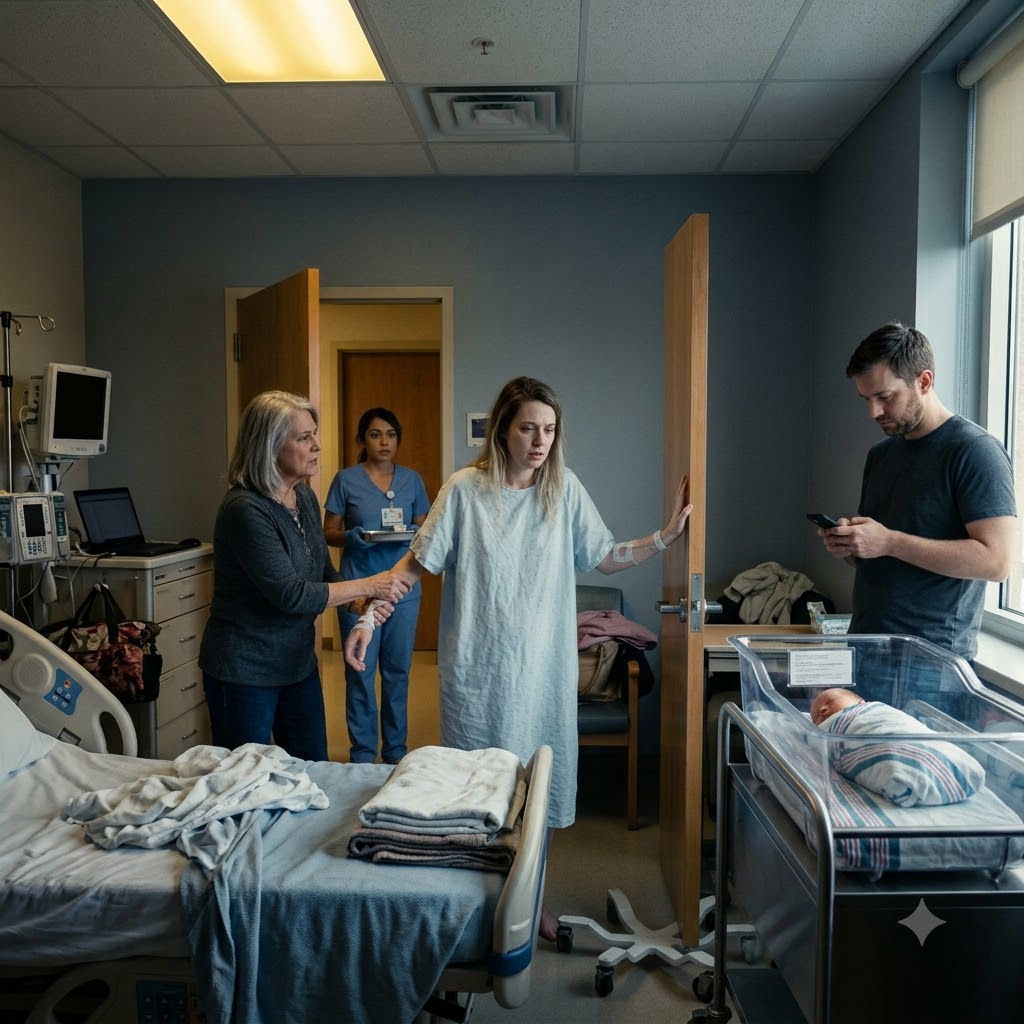
My ex rushed into my emergency room with his injured daughter in his arms, never imagining the doctor waiting for him would be me—the woman he had walked away from months earlier. And he definitely never expected to see me seven months pregnant with a baby he didn’t even know existed.
I didn’t cry. I didn’t freeze. I didn’t let him see what his presence did to me.
“I’m Dr. Adelaide,” I said calmly, pretending not to notice how quickly his eyes dropped to my stomach.
But hours later, when his daughter whispered one innocent sentence, every bit of color left his face.
The night Elias came through the emergency room doors carrying Sophie, he expected panic, paperwork, nurses rushing around, and maybe frightening news.
He did not expect me.
And he certainly did not expect to find me standing under the harsh hospital lights, visibly pregnant, one hand resting over the life growing inside me.
For one breath, the entire room seemed to stop.
I stood outside Trauma Bay Two with a stethoscope around my neck and my hair tied back in a rushed ponytail. Months of private heartbreak had taught me to keep my face steady. Medical school had trained me for emergencies, frightened parents, and difficult moments.
But nothing had trained me for seeing Elias again.
“Daddy, my arm hurts,” the little girl whispered from the stretcher.
His expensive suit was wrinkled. His tie hung loose. The polished businessman I remembered was gone, replaced by a terrified father holding on too tightly to his child.
For once, Elias didn’t look powerful.
He looked scared.
I took a slow breath.
“I’m Dr. Adelaide,” I said gently. “What’s your name, sweetheart?”
The little girl blinked through tears.
“Sophie.”
“What happened, Sophie?”
“I fell off the monkey bars.”
“At school?”
She nodded.
“Daddy got really scared.”
The irony almost made me react. Elias, the man who never knew how to show fear, was trembling because his daughter was hurt.
I stepped closer.
“I’m going to examine you carefully, okay? You tell me if anything hurts too much.”
“Okay.”
Only then did I look at him.
“Sir, please step back a little while we check her.”
Our eyes met.
Six months disappeared in an instant.
First came recognition.
Then shock.
Then his gaze moved to my stomach.
His face changed completely.
“Adelaide,” he whispered.
Not Doctor.
Adelaide.
The way he used to say my name on quiet mornings, back when I still believed we might have a future.
I turned away.
“Let’s get imaging on her arm and complete the routine checks,” I told the nurse.
The team moved quickly around us.
I examined Sophie with steady hands and a calm voice, but I could feel Elias watching me the entire time.
I knew what he was calculating.
Seven months pregnant.
Six months apart.
Six months since the rainy afternoon in his kitchen when I had finally asked the question I had been afraid to ask.
“Do you love me, Elias?”
He hadn’t answered.
Not really.
Instead, he told me he didn’t know how to give me the kind of life I wanted.
So I left.
A few weeks later, alone in my bathroom with a positive pregnancy test in my hand, I realized I wasn’t leaving that life empty-handed.
“Dr. Adelaide?”
Sophie’s voice pulled me back.
“Yes, sweetheart?”
“You’re really pretty.”
I smiled softly.
“Thank you.”
Her eyes moved to my belly.
“Are you having a baby?”
“I am.”
“That’s wonderful,” she said. “I always wanted a little sister.”
Behind me, Elias inhaled sharply.
No one else noticed.
But I did.
Thankfully, Sophie’s scans showed nothing serious. She had a small wrist fracture and needed to stay overnight for observation, but she would be fine.
By late evening, she was comfortable upstairs.
The emergency was over.
The silence that came after felt much harder.
I found Elias alone in a consultation room, staring out at the city lights.
“Sophie is doing well,” I said.
He turned slowly.
“Is the baby mine?”
His voice held a vulnerability I had never heard from him before.
Without thinking, I placed my hand over my stomach.
“Your daughter needs you right now,” I said. “Focus on her.”
“Adelaide…”
“No.”
My voice trembled, even though I tried to keep it firm.
“You don’t get to ask that after vanishing for six months.”
His face filled with regret.
“I didn’t know.”
“You never tried to know.”
“I thought you wanted space.”
“I wanted you to choose us.”
The words came out before I could stop them.
He looked broken.
“I was scared,” he admitted.
“Yes,” I said quietly.
“Can we talk?”
“Some conversations arrive too late.”
Then I walked away.
Hours later, I sat alone in the hospital cafeteria, staring at a cup of coffee that had gone cold.
Outside, the city shimmered under the night sky.
My phone vibrated.
A message from Elias.
My chest tightened.
The text was simple.
Sophie keeps asking for the kind doctor with the baby. She can’t sleep. Would you mind checking on her?
I went upstairs. Sophie was half-asleep, her casted arm resting carefully on a pillow. When she saw me, her eyes lit up.
“You came,” she whispered.
“Of course I did.”
Elias stood in the corner, quiet, watching us. When Sophie finally drifted off, he followed me into the hallway.
“I don’t expect anything,” he said. “I just… needed you to know I’m not the same man who let you walk out into the rain.”
I didn’t answer. I simply turned and left.
That weekend an elegant box appeared outside my apartment door. No return address. Only a cream card under a black ribbon.
*Adelaide, some wars cannot be fought alone, especially the ones involving him. Look inside.*
Inside was a hand-knitted seafoam-green baby blanket and rare vintage pediatric medical books. Expensive. Thoughtful. Impossible to ignore.
It was not from Elias.
On Sunday afternoon someone knocked. I opened the door and found Elias standing there with Sophie, her arm still in a white cast.
“Doctor Adelaide!” Sophie held up a container. “Dad and I made cookies. He burned the first batch, but these are good.”
I laughed before I could stop myself.
Elias looked embarrassed. “We’re trying to earn forgiveness with sugar. May we come in?”
Against my better judgment, I stepped aside.
Sophie immediately noticed the ultrasound photo on my refrigerator. “Is that the baby? It looks like a little bean.”
“It’s getting bigger every day,” I said.
Elias watched me quietly. Then he pulled a velvet-wrapped object from his coat and placed it on the counter.
“I didn’t bring this to buy forgiveness,” he said softly. “I brought it because I want you to know what I’ve been doing since you left.”
Inside was an antique wooden music box. Old and beautiful, carefully repaired where the wood had splintered and the gears had rusted.
“It was destroyed when I found it,” Elias said. “I spent five months fixing it because I don’t know how to fix things with words.”
He turned the brass key. A delicate waltz filled the kitchen.
“It still has scars,” he said, touching a repaired crack. “But it plays. That has to count for something.”
Before I could respond, the intercom buzzed.
“Doctor Adelaide? A woman named Genevieve is here to see you.”
Elias froze.
“Who is Genevieve?” I asked.
“My ex-wife,” he said.
Five minutes later a stunning woman in an immaculate trench coat stepped into my apartment. Her eyes went straight to Elias.
“Hello, Elias. I see you finally found your courage,” she said, then turned to me. “And you must be Adelaide. You received the blanket?”
“You sent it?” I asked.
“Sophie talks to me every night. She mentioned the pretty doctor who looked very sad a few months ago. I put the pieces together.”
Elias stepped forward. “Why are you here?”
“To warn her,” Genevieve said calmly. Then she looked at me. “Every woman who loves a broken man needs one.”
She walked to the music box. “I loved him for four years. I thought I could melt the walls he built after his parents died. He was never cruel, but he was a coward. I left because I refused to be a ghost in my own marriage. If he is fixing music boxes and showing up at your door, then he is doing for you what he never could do for me.”
She touched my arm gently. “He cares about you more than his fear. But make him earn every inch.”
Then she kissed Sophie’s head and left.
I turned to Elias.
“Is she right?”
“Every word,” he said, eyes wet. “But I don’t want to be that man anymore.”
Before I could answer, sharp pain tore through my abdomen. My knees buckled.
“Adelaide!”
Elias caught me as everything went dark.
( End of Part 1 )
Read Part 2 of the story in the first comment below 👇👇👇
I woke to hospital monitors.
“The baby?” I gasped.
“The baby is holding strong,” said Naomi, my closest friend and senior obstetrician. “Severe preeclampsia caused your blood pressure to spike. You were lucky Elias got you here when he did.”
I tried to sit up. “I need to get back to work.”
“You are the patient now,” Naomi said firmly. “Strict bed rest until delivery.”
Tears slipped down my face.
When Naomi left, Elias took my hand. “I canceled my schedule for the next two months. I stepped back from the board. I’m not leaving you.”
“You can’t pause your whole empire for me.”
“There is no empire without you,” he said. “I almost lost you today. I won’t run again.”
For the next two weeks I stayed in Elias’s brownstone. He learned to check my blood pressure, made low-sodium meals, read to me when anxiety became too heavy, and never once made me feel like a burden. Genevieve visited with Sophie, and strangely, I began to treasure her sharp, honest support.
Slowly, I trusted him—not because of his words, but because of what he did every day.
At thirty-two weeks I had an in-person ultrasound. Elias drove me to the hospital with intense caution. The main elevators were crowded, so I suggested the old service elevator.
“It’s fine,” I said. “I used it during residency.”
We stepped inside. The doors closed. The elevator groaned upward.
Then it jolted violently and stopped.
The lights flickered out.
Darkness swallowed us.
Elias found his phone. No signal.
“We wait,” I said, trying to sound calm.
Then warm fluid rushed down my legs.
I froze.
“Elias,” I whispered. “My water just broke.”
Panic crossed his face. “You’re only thirty-two weeks.”
A contraction tore through me. I cried out and gripped the rail.
“I don’t know how to deliver a baby,” he said, voice breaking.
“I do,” I gasped, grabbing his lapels. “I’m the doctor. You are my hands. Listen to me, and we will save our daughter together.”
Another contraction hit.
The dark elevator became the whole world. Elias took off his jacket, put it behind my head, and laid his shirt beneath me. His hands shook, but his eyes stayed on mine.
“Tell me what to do.”
“When she comes, catch her gently. Check the cord. If she doesn’t cry, rub her back and clear her mouth.”
“I won’t let her go.”
Then the urge to push became impossible to fight.
“Now!” I screamed.
In the dark, trapped between fear and hope, I fought for my baby’s life. Elias did not flinch. He spoke to me through every second.
“One more, Adelaide. I see her.”
With one final push, the pressure released.
Then silence.
“Elias?” I whispered. “Is she breathing?”
“Come on,” he begged. “Breathe for your mother. Breathe for me.”
Then a tiny cry pierced the dark.
I sobbed.
He placed our daughter on my chest. She was impossibly small, but alive.
The lights returned. The elevator descended and opened to Naomi and a team of panicked staff.
“Get a gurney!” Naomi shouted.
We named her Hope.
For three weeks she stayed in the NICU, growing stronger every day. Elias never left. He slept in a plastic chair beside her incubator and promised her a lifetime of safety.
On the day Hope was cleared to go home, Elias brought me a leather-bound book.
Inside was a hand-drawn blueprint of a house designed for us: Adelaide’s medical library, Sophie’s greenhouse, Hope’s room. Page after page held a ten-year plan—not controlling, but hopeful.
On the final page, he had written:
*I am done running from the light.*
*Will you help me build this, Adelaide?*
Then he knelt with a simple braided gold band.
“I want the terrifying, beautiful mess of loving you for the rest of my life. Marry me, Adelaide. Build a life with me.”
I looked at Hope sleeping against my chest.
Then at the man who had delivered her when all the lights went out.
“Yes,” I whispered.
Three years later, the house from the first blueprint became real. Sophie played piano badly in the living room. Hope laughed nearby. A golden retriever barked at squirrels. I made pancakes while Elias came home with coffee beans and kissed flour from my nose.
The antique music box played its soft waltz in the corner.
Broken things, beautifully repaired.
I learned that love is not about finding someone unbroken. It is about finding someone brave enough to sit with you in the dark, fix what can be fixed, and walk with you into the light.