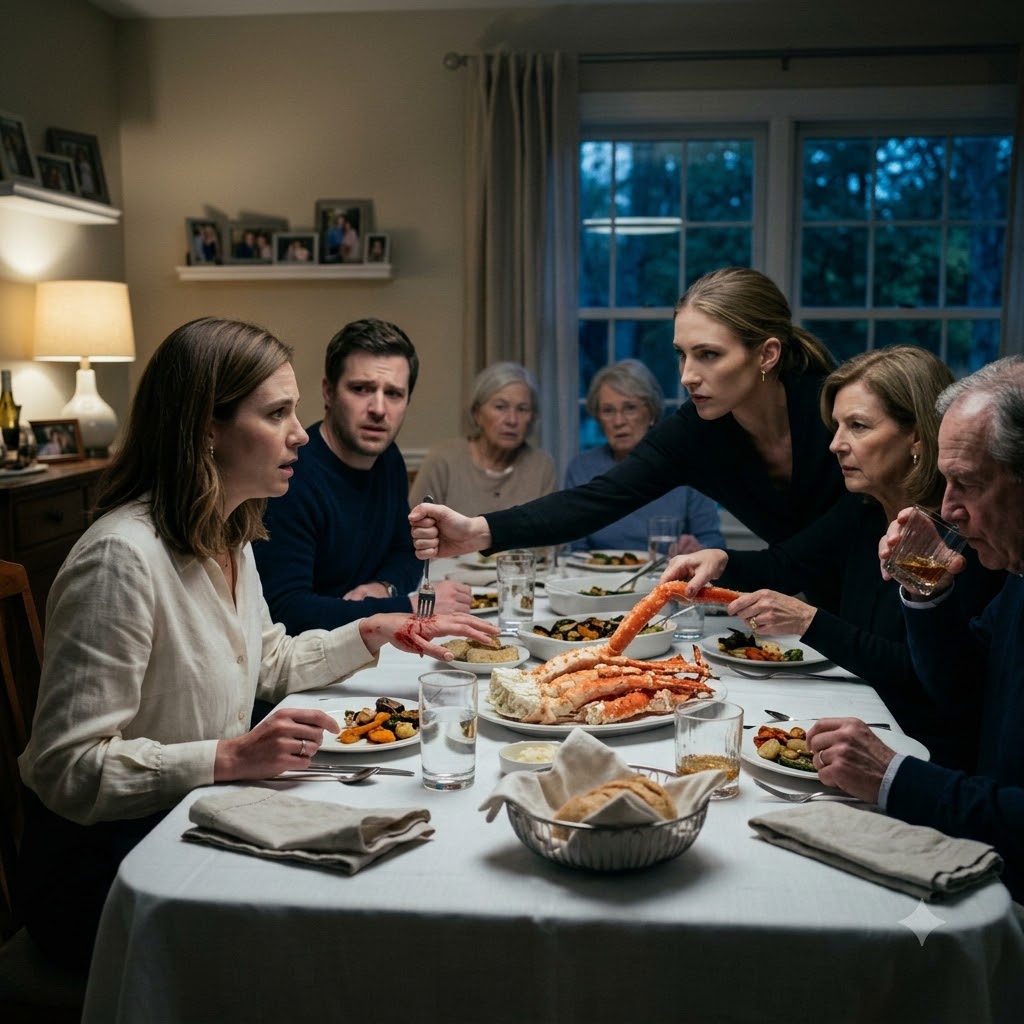
She Poured Red Wine on Me Thinking I Was Just a Waitress… Until My Husband Walked In and Changed Everything
She smiled into her phone as red wine poured down the front of my white shirt. To her, humiliating me was still a joke because the last time she had known me, I was the poor girl from high school who never seemed good enough. What she didn’t know was that she had just done it inside my restaurant—and that within minutes, she was supposed to meet one of the people who could decide whether her firm landed a major financial account.
I was standing beside her table in one of the busiest dining rooms I owned, holding a tray with two glasses of sparkling water while the stain spread across my chest. I had worked years to build this place, survived bad leases, payroll scares, broken equipment, and the terrifying first year when one empty weekend could ruin everything. Yet Lauren Pierce had looked at my plain white shirt and black pants and decided none of that could possibly be true.
“Maya! It’s been forever. Since high school, right?”
I had recognized her before she recognized me. Same polished blond hair. Same expensive smile. Same eyes that measured people before deciding how much respect they deserved.
Lauren had been one of the girls who made high school miserable for me. Back then, my clothes came from thrift stores, my grades were average, and I worked after school because my family needed the money. Lauren knew exactly which weaknesses to use. She mocked my clothes, my grades, my mother, even the way I smelled after working around cleaning supplies. Whenever I reacted, she called it a joke.
Seventeen years later, she was still laughing.
She looked me up and down. “Oh… so this is what you do now?”
I let her keep talking.
“Makes sense,” she added. “You were never exactly great at school.”
That sentence brought back more than I wanted to remember, but I wasn’t seventeen anymore. I didn’t need to explain myself. I didn’t need to tell her I had opened my first restaurant at twenty-six, or that the company now owned several locations and was preparing to expand into two more cities. I didn’t need to tell her my husband had not created my career, funded my first restaurant, or turned me into someone important.
So instead I asked what she had been doing.
Lauren immediately told me.
Wealth management. Major clients. A competitive promotion. A huge potential account her firm was trying to win. She spoke like every sentence was another rung on a ladder.
Then she lifted her phone.
“We need a reunion picture.”
Before I could answer, she leaned closer and raised the camera.
“Say cheese!”
Her wineglass tipped.
Red wine splashed directly onto me.
For one second, I simply stared at the stain.
Then I looked at her.
“You still haven’t grown out of bullying people, have you?”
Lauren laughed.
“Come on. It’s just a joke.”
That was when I knew adulthood had changed her clothes, her salary, and her business card, but apparently not much else.
She reached for a napkin without any real concern. “Seriously, Maya. Don’t make a thing out of it.”
I almost smiled.
Lauren believed she had all the information she needed. I was a waitress. She was a successful wealth manager. The old social order had somehow survived intact.
What she didn’t know was that I often worked the floor in my own restaurants because I wanted to know what my guests and employees were experiencing. My executive team kept telling me founders were supposed to stay upstairs and let managers handle everything. I disagreed. Restaurants lived or died six feet from the customer.
So yes, sometimes I carried water.
Sometimes I cleared plates.
Sometimes someone mistook me for an employee.
Usually that told me something interesting about them.
Lauren had told me plenty.
Before I could answer her, a familiar voice sounded behind me.
“Hello! I hope I’m not too late.”
I saw Lauren change before I even turned around.
Her back straightened. Her face brightened. The smugness disappeared beneath a polished professional smile.
Ethan Bennett walked toward our table in a charcoal suit.
My husband.
Lauren stood immediately.
“Hello, sir. It’s a pleasure to finally meet you.”
There was such warmth in her voice now that I almost admired the speed of the transformation.
Ethan shook her hand.
“Lauren Pierce?”
“Yes. Absolutely. Thank you for making the time.” She gestured around the dining room. “Beautiful restaurant you picked.”
Ethan’s eyes moved to me.
Then to the red stain on my shirt.
His expression changed.
“What happened?”
Lauren answered before I could.
“Nothing. Just a little accident.”
I could see the calculation starting behind her eyes. Ethan was clearly the important client she had mentioned. She wanted him comfortable. She wanted him impressed. And as far as she knew, I was simply an embarrassing person from her past standing too close to a major opportunity.
She gave me a small warning look.
Don’t make this difficult.
I remembered that look too.
In high school, it had meant the same thing.
Accept the joke.
Stay quiet.
Know your place.
But Ethan knew me well enough not to speak for me. He waited.
I dabbed the wine with a napkin.
“Apparently I’m still sensitive about jokes.”
Lauren’s face tightened.
“Maya, please.”
Ethan glanced between us, clearly understanding there was more happening than he had walked in on.
I could have exposed Lauren right there. I could have described high school. I could have told him exactly how deliberate the wine had looked.
I didn’t.
I didn’t need him to rescue me.
That mattered.
Ethan and I had money together, investments together, and a holding company together, but my restaurants were not some gift he had handed his wife. I had a career before our marriage. My company had its own investors, its own reputation, its own employees, and its own future.
We were a power couple because both of us had built something.
Lauren simply didn’t know that yet.
She turned back to Ethan, apparently hoping to move on.
“I really am sorry about the interruption. Shall we sit?”
Ethan didn’t move.
Instead, he looked around the dining room again, then back at me.
Lauren followed his eyes, confused.
He noticed my wine-soaked shirt one more time.
Then he lifted his hand and pointed straight at me.
Read PART 2 of this story in the first comment below
👇👇👇
“It’s my wife’s restaurant,” Ethan said. “I guess you two already had a chance to meet.”
Lauren stopped breathing for about three seconds.
“Your… wife?”
Ethan looked at my shirt again. “What happened?”
Lauren immediately called the wine an accident. I let her. Instead of exposing her, I called my general manager over. “Daniel, would you take care of this table?”
“Yes, Ms. Bennett.”
Lauren’s face changed again.
“Enjoy dinner,” I told her. “It’s on the house.”
That was almost worse than yelling. Every employee around us knew exactly who I was while Lauren sat there realizing she had mocked the owner, poured wine on her, and then tried to impress the owner’s husband.
But her real problem came upstairs.
Ryan Cole, Lauren’s boss, joined us for the business meeting. Lauren recovered enough to give a strong presentation. She knew investments. She understood portfolio structure. For a while, I could almost see her convincing herself the restaurant incident no longer mattered.
Then the conversation turned to the account itself.
The potential mandate was significant. Lauren assumed Ethan was the decision-maker, so most of her presentation remained directed toward him.
I watched.
Ethan watched too.
When the meeting ended, Lauren caught me alone.
“We were kids,” she said quickly. “I hope we can be adults about this.”
“I am being an adult.”
“Then you won’t let something from high school affect business.”
I stared at her.
“Lauren, you poured wine on me three hours ago.”
Her apology became defensive almost instantly. She insisted it had been an accident, then finally asked what I actually did.
“I own restaurants.”
She clearly thought I meant one.
By Monday, she had discovered the truth. My company owned multiple locations and was preparing major expansion into Chicago and Austin. Even worse for Lauren, an investment fund her firm wanted badly was also discussing an investment in my business.
Suddenly I was connected to two opportunities she cared about.
That was when the expensive gifts started.
I sent every one back with the same message: “Let’s keep this professional.”
Ryan soon learned enough to realize Lauren had created a serious problem. He met with me personally and asked whether her behavior would affect my judgment of his firm.
“It affects my judgment of Lauren,” I said. “Not necessarily your company.”
That distinction saved Hawthorne from being dismissed immediately.
But Lauren still had one thing left to learn.
During the formal account discussion, Ethan waited until she finished another confident explanation.
Then he closed the presentation binder and turned toward me.
Ethan told me about the meeting over dinner.
Not at one of my restaurants.
At home.
I was barefoot at the kitchen island, eating noodles out of a takeout carton because apparently owning restaurants made cooking at ten-thirty at night feel even less reasonable.
Ethan set his fork down.
“Lauren gave me a revised proposal today.”
I looked up.
“How revised?”
“Very.”
“Better fees?”
“Much.”
“That sounds good.”
“It would.”
His expression told me there was more.
I waited.
“She also suggested we move the conversation forward without you.”
I stopped chewing.
“What?”
“She thinks you’re allowing personal history to distort your judgment.”
I stared at him.
He rubbed one hand over his jaw.
“She was careful about how she said it.”
“I bet.”
“She framed it as protecting the economic opportunity.”
I put the carton down.
“And you said?”
“I asked her, ‘Did you just ask me to go around my wife on an account she partially owns?’”
I closed my eyes.
“Oh, Lauren.”
“She realized the mistake about halfway through my sentence.”
“Did she answer?”
“Not effectively.”
For several seconds, I said nothing.
Then I started laughing.
I couldn’t help it.
The entire thing was absurd.
Lauren had spent our teenage years assuming I was stupid.
Now, as an adult, she had apparently concluded that the sophisticated path to winning business was convincing my husband I was too emotional to make decisions about my own money.
Ethan watched me.
“So?”
“So what?”
“Do you want Hawthorne removed?”
“No.”
He raised an eyebrow.
“No?”
“No.”
“Even after that?”
“Lauren is not Hawthorne.”
That was the moment the idea occurred to me.
Not revenge.
Opportunity.
There was something my company needed anyway.
We were preparing to appoint an outside advisory group for part of the expansion capital and treasury portfolio.
Multiple firms were already being considered.
Hawthorne was qualified.
So I invited them.
When Ryan received the request for proposal, he called me personally.
“We’d be very interested.”
“I assumed.”
“Is Lauren involved?”
“That is your decision.”
Silence.
Then, cautiously, “She has the relationship.”
I smiled to myself.
“If that’s what you call it.”
Ryan laughed despite himself.
Two days later, Lauren emailed me.
Professional.
Concise.
No gifts.
No fake nostalgia.
Thank you for including Hawthorne in the process. I look forward to presenting our capabilities.
Better.
I responded with scheduling details.
What Lauren didn’t realize was that I wasn’t setting a trap.
I wanted to know who could manage our money well.
The presentation room held nine people.
Three from my side.
Three from Hawthorne.
Two members of our board’s finance committee.
And Ethan, who had absolutely no reason to attend except that he’d asked whether he could watch.
“You’re terrible,” I told him.
“I care deeply about treasury management.”
“You couldn’t define duration risk yesterday.”
“I’ve grown.”
Lauren sat at the center of Hawthorne’s side.
To her right was Ryan.
To her left sat a younger woman named Nina Patel.
Maybe twenty-eight.
Quiet.
Prepared.
I’d read her bio beforehand.
Five years in portfolio analytics.
MBA at night.
Specialization in risk modeling.
Lauren began the presentation.
And again, I was reminded that she was not incompetent.
She knew how to sell.
She was poised.
Confident.
Polished.
Her slides were excellent.
The problem came when selling stopped and questions began.
“What percentage of the proposed allocation would be exposed to duration beyond five years?” I asked.
Lauren glanced at a page.
“Our model is designed to preserve flexibility.”
“That wasn’t my question.”
A pause.
Nina looked toward Lauren.
Lauren continued.
“Approximately twenty percent, depending on market conditions.”
Nina shifted.
I noticed.
“What is it today?”
Lauren checked again.
“Between seventeen and twenty.”
Nina spoke quietly.
“Fourteen-point-eight under Friday’s close.”
Lauren looked at her.
So did I.
“Thank you,” I said.
Then I asked about fees.
Lauren gave me the published schedule.
I asked about breakpoints.
She hesitated.
Nina answered.
I asked how they would handle a potential conflict if the same fund participating in our equity round also became a Hawthorne relationship.
Lauren said their compliance group would review it.
“What does that mean operationally?”
Another pause.
Nina explained the information barriers.
Ryan said very little.
He was watching the same thing I was watching.
Lauren knew how to make the room feel good.
Nina knew what was inside the product.
After forty minutes, Lauren’s confidence had begun to crack.
She interrupted Nina twice.
The second time, I held up a hand.
“Thank you, Lauren.”
Her mouth closed.
“I think I’d like to hear from your colleague now.”
The silence was brutal.
Not because I had raised my voice.
Because I hadn’t.
Nina looked startled.
Then she continued.
Lauren sat back.
For the next twenty minutes, the younger woman answered nearly every question.
Liquidity.
Custody.
Counterparty exposure.
Concentration.
Tax reporting.
Operational risk.
She wasn’t flashy.
She was good.
When the meeting ended, I thanked everyone.
Lauren did not look at me.
I should have known that would not last.
I was in the restroom washing my hands when the door opened hard behind me.
Lauren walked in.
The door shut.
For a second, we only looked at each other through the mirror.
Then she said, “Was that fun?”
I dried my hands.
“What?”
“You know exactly what.”
She was shaking.
Not with fear.
Humiliation.
“You invited me here to do that.”
“To ask questions?”
“To embarrass me.”
“I invited your firm because your firm is qualified.”
“Don’t.”
Her voice sharpened.
“Don’t pretend this isn’t about high school.”
I turned to face her.
“No.”
She laughed bitterly.
“No?”
“No.”
“If you wanted to make me look incompetent, congratulations.”
“I didn’t make you look incompetent.”
“You kept asking questions you knew Nina would answer.”
“I asked questions I need answered before I give someone responsibility for millions of dollars.”
“You could have asked me privately.”
“Why?”
Her face went blank.
“Because this was my presentation.”
“No, Lauren.”
I stepped closer.
“This was your firm’s presentation.”
That distinction landed.
“You don’t get to turn everyone around you into supporting characters and then accuse them of betrayal when they know their jobs.”
“You chose her over me because you hate me.”
“I haven’t chosen anyone yet.”
“But you will.”
“Based on the work.”
She stared at me.
Then the words came out.
“You wanted revenge.”
I studied her face.
“No.”
“Liar.”
“If I wanted revenge, I’d tell everyone here exactly who you used to be.”
Her mouth tightened.
“Then what do you call this?”
“Business.”
The word hung between us.
Lauren looked almost disappointed.
I think part of her wanted revenge.
Because revenge would have made sense to her.
It would have made us equal participants in the same old game.
She hurt me.
I hurt her.
Score settled.
But that wasn’t what was happening.
I didn’t ask her to misunderstand me in my own restaurant.
I didn’t ask her to spread rumors.
I didn’t ask her to circumvent me with Ethan.
I didn’t ask her to walk into a pitch unprepared for questions another member of her team could answer.
Those were her choices.
I had simply stopped cushioning the consequences.
She stepped closer.
“You think you’re better than me now.”
“No.”
“You absolutely do.”
“I think you still decide what people are worth before they open their mouths.”
Her eyes narrowed.
“And I think you’re furious because you got the calculation wrong with me.”
She walked out.
For two hours afterward, nothing happened.
Then my phone began buzzing.
First a message from an old high school acquaintance.
Then another.
Then three screenshots.
Lauren had posted the selfie.
The selfie from the restaurant.
Caption:
Funny who you run into after all these years. Some people really do marry well. From cafeteria queen to waitress to Mrs. Bennett. Life is wild.
I stared at the screen.
There were so many things wrong with it I didn’t know which one to process first.
I had never been cafeteria queen.
Then I noticed the photograph itself.
Lauren had chosen the exact frame from the moment the wine spilled.
My eyes were turned downward.
Her glass was angled.
And a visible stream of red wine ran directly onto my white shirt.
I zoomed in.
“Oh no.”
Ethan looked over.
“What?”
I handed him the phone.
He stared at it.
Then his face changed.
“She posted this?”
“Yes.”
“Publicly?”
“Yes.”
A notification appeared.
Someone had commented.
I recognized the name immediately.
Jessica Lane.
High school.
Not a close friend.
But she’d been there.
Her comment read:
Lauren, are you seriously posting this like it’s funny? You bullied Maya constantly in high school. This photo literally looks like you’re pouring wine on her.
Then another person replied.
Wait, that’s MAYA BENNETT? The restaurant founder?
Another:
Isn’t Bennett Hospitality hers?
Another:
Didn’t she open the first restaurant before marrying Ethan?
Someone posted an article.
Someone else posted the company website.
Then a local hospitality reporter apparently saw the thread.
Within an hour, the post had escaped Lauren’s followers.
By evening, she deleted it.
Too late.
Screenshots had spread through exactly the community Lauren needed to impress.
Bankers.
Advisors.
Founders.
Private wealth executives.
The people who knew me knew the waitress joke wasn’t clever.
The people who didn’t know me now had access to five years of press coverage and corporate filings explaining exactly who owned what.
Lauren had tried to make me look small.
Instead, she’d created a searchable record of herself doing almost exactly what I had accused her of doing.
Judging people according to status.
Ryan called me the next morning.
His voice was exhausted.
“Maya.”
“Ryan.”
“I assume you’ve seen it.”
“Yes.”
“I want to be clear. Lauren’s post does not reflect Hawthorne.”
“I didn’t assume it did.”
“We’re reviewing the situation.”
“All right.”
He hesitated.
“I also want you to know this will not affect the team assigned to your proposal.”
“I think it already has.”
Silence.
Then Ryan said quietly, “Fair.”
By noon, Ethan officially declined Lauren’s revised private-wealth proposal.
Not Hawthorne.
Lauren’s proposal.
There were other firms we preferred.
By four, I made my decision on Bennett Hospitality.
Hawthorne would get part of the mandate.
With one condition.
The lead team would be Ryan and Nina.
Not Lauren.
When I told Ryan, he didn’t argue.
“Understood.”
“Your firm did good work.”
“Thank you.”
“Nina especially.”
“I agree.”
Another pause.
Then he said, “Lauren won’t receive credit for the account.”
That wasn’t something I’d requested.
“That is internal.”
“It is.”
“Then handle it internally.”
“We will.”
I ended the call.
I should have felt victorious.
Instead I felt tired.
Because Lauren was still looking for the person who had done this to her.
She hadn’t yet realized she needed a mirror.
Lauren came into my restaurant at four-thirty on a Tuesday.
Before dinner service.
No reservation.
No client.
No polished wealth-management smile.
She walked past the host stand like the room owed her something.
I was near the bar reviewing the night’s private-event setup when one of our managers approached me.
“Ms. Bennett?”
“I see her.”
Lauren spotted me.
She came straight over.
“We need to talk.”
I closed the event sheet.
“Hello to you too.”
“Privately.”
I looked at my manager.
“I’ll handle it.”
He nodded but didn’t go far.
Smart man.
Lauren waited until we reached the quieter corridor near my office.
Then she turned on me.
“You ruined my career.”
There was no preamble.
No performance.
For the first time since we’d met again, Lauren Pierce sounded exactly as angry as she felt.
“No.”
“Don’t give me that.”
Her face was pale.
“I’ve been removed from promotion consideration.”
“I didn’t make that decision.”
“Because of you.”
“Because of what happened.”
“Which you made happen.”
I stared at her.
“Did I write your post?”
Her jaw clenched.
“Did I tell you to go around me with Ethan?”
Nothing.
“Did I tell you to spread a lie about how my company was funded?”
“You made every one of those things matter.”
That sentence stopped me.
Not because it was true.
Because it explained her completely.
“You really believe that.”
She folded her arms.
“You had the power.”
“No.”
“Yes.”
“You walked into my restaurant, looked at my shirt, and decided you knew my whole life.”
She opened her mouth.
I stepped closer.
“Then you did exactly the same thing in every room after that.”
She stared at me.
“You decided the woman carrying water had failed.”
I counted it off.
“Then you decided the founder married into her company.”
Another.
“Then you decided the wife couldn’t be trusted with financial decisions because she was emotional.”
Another.
“Then you decided your younger colleague answering questions was betrayal instead of competence.”
Her breathing had changed.
“And when none of those stories worked, you posted another one.”
“Maya—”
“You never changed the habit.”
My voice was quieter now.
“You just changed the explanation.”
Lauren looked away.
For a few seconds, I could hear the kitchen through the wall.
Knives.
Metal.
Someone laughing.
The ordinary sound of people preparing for service.
Lauren said, “You don’t know what this promotion meant.”
“No.”
“I’ve worked for it for six years.”
“I believe you.”
Her eyes snapped back to mine.
“I’ve brought in more new assets than half the people above me.”
“I believe that too.”
“My father told me finance wasn’t for women unless they wanted to be assistants.”
That surprised me.
Not the sentence.
The fact that she told me.
“I spent my entire twenties proving him wrong.”
I said nothing.
“I have men in that office who can walk into a meeting half-prepared and people call them confident.”
Her voice shook.
“If I miss one answer, I’m difficult. If I push, I’m aggressive. If I hesitate, I’m not ready.”
There it was.
The pressure beneath the armor.
For one brief moment, I could see how Lauren had built herself.
Status wasn’t just vanity to her.
It was safety.
Proof.
A scoreboard she could point to whenever somebody tried to make her smaller.
I understood that more than she probably imagined.
But understanding someone’s wound did not require volunteering to be cut by it.
“I believe all of that,” I said.
Her expression shifted.
“Then how can you stand there and act like this is fair?”
“Because you had pressure.”
I nodded.
“So did I.”
She went still.
“And you used yours to become very good at entering rooms where you thought people mattered.”
My voice hardened.
“But you never learned how to treat people when you thought they didn’t.”
Lauren looked as if I’d slapped her.
Good.
Not because I wanted pain.
Because some truths should sting.
“You hated me,” she said.
“In high school?”
“Yes.”
“Yes.”
The honesty surprised her.
“I hated you.”
I remembered exactly how much.
I had hated her on the bus home.
I had hated her while washing dishes at the diner where I worked after school.
I had hated her while studying algebra at midnight because I was exhausted and couldn’t understand half of it.
I had imagined speeches.
Reunions.
Success.
Some future day when Lauren Pierce would see me and realize I mattered.
Then life became too busy.
There were bills.
Jobs.
Restaurants.
Payroll.
Rent.
Permits.
A marriage.
Losses.
Wins.
People I loved.
People I employed.
At some point, Lauren became a smaller and smaller room in a house I’d stopped visiting.
“I don’t hate you now,” I said.
She laughed without humor.
“That’s convenient.”
“It isn’t a compliment.”
Her expression tightened.
She stared past me toward the dining room.
“This is what you wanted.”
“What?”
“All of it.”
Her eyes came back to mine.
“You’re enjoying this.”
I could have denied it.
That would have been the elegant answer.
The mature one.
The answer people expect from someone who has reached the top of a story and wants everyone to know success purified her.
But it would have been a lie.
So I looked at Lauren for a long moment.
“A little.”
She froze.
I almost smiled.
“I’m only human.”
Her face went completely blank.
It was probably the first honest thing between us that she knew how to trust.
I continued.
“Did I enjoy seeing your face when Ethan told you this was my restaurant?”
Silence.
“Yes.”
Her mouth opened slightly.
“Did I enjoy watching you discover that the person you dismissed had built something?”
“Yes.”
Another beat.
“Did I enjoy taking away your promotion?”
Her shoulders stiffened.
“No.”
That one mattered.
“Because I didn’t.”
She looked skeptical.
“I didn’t call Ryan and demand you be punished. I didn’t ask Ethan to blacklist you. I didn’t exclude Hawthorne.”
I pointed toward my office.
“I gave your company business.”
“Not me.”
“Because someone else was better.”
That landed hardest.
Her eyes flashed.
“Nina wasn’t better.”
“She was in that meeting.”
“You set me up.”
“No.”
I shook my head.
“I asked questions.”
“You knew—”
“I knew my own balance sheet.”
My voice rose for the first time.
“You were asking me to trust you with my company’s money, Lauren. What did you think the meeting was?”
She said nothing.
“A popularity contest?”
Still nothing.
“High school?”
Her face hardened again.
There it was.
The old defense returning.
But weaker.
Ryan had apparently transferred her out of the marquee private-client group.
Not fired.
Not destroyed.
Not blacklisted.
Just moved.
A smaller client segment.
Less prestigious accounts.
No promotion this year.
She would have to rebuild.
That was why she was standing in front of me.
Not because her career was over.
Because for the first time in years, there was no shortcut between where she was and where she believed she deserved to be.
“I have to start over,” she said.
“You don’t.”
“That’s easy for you to say.”
“You’re thirty-two, not seventy.”
She glared.
“You still have a job. You still have experience. You still have clients.”
“You think that’s supposed to comfort me?”
“No.”
I picked up the event sheet I’d set on the console.
“I think it’s supposed to be accurate.”
Lauren stared at me for another second.
Then she turned.
I watched her walk through the dining room.
Past the bar.
Past the tables.
Past the host stand.
No one laughed.
No one humiliated her.
No one threw wine.
She simply left.
Six weeks later, Bennett Hospitality closed the funding round.
The valuation was better than we’d expected.
Not absurd.
Not fantasy-money.
But enough to change what we could build and how fast we could build it.
Chicago moved first.
Austin followed.
The local business press wanted interviews.
I did some.
Declined others.
Then City Ledger asked me to sit for a feature about female founders reshaping the city’s hospitality industry.
The article focused on three of us.
My face made the cover.
When the magazine arrived, I was working at the restaurant.
Naturally.
I was in the back reviewing vendor invoices when Ethan walked in carrying three copies.
He placed one directly over my spreadsheet.
I looked down.
There I was.
Arms folded.
Dark suit.
One of our dining rooms blurred behind me.
The headline read:
THE WOMEN BUILDING THE CITY’S NEXT GENERATION OF COMPANIES
Ethan tapped my photograph.
“Not bad for someone who wasn’t exactly great at school.”
I looked at him.
“Don’t start.”
He grinned.
“I’ve been saving that for two months.”
“You’re very proud of yourself.”
“Extremely.”
I slid the magazine aside.
He put it back.
“You’re keeping one.”
“We have the digital version.”
“Maya.”
I sighed.
“Fine.”
He kissed my forehead.
Then I looked down at the cover again.
The strange thing was that I didn’t think about Lauren.
Not immediately.
I thought about my mother.
About the first restaurant.
About being twenty-six and signing a lease so terrifying I threw up afterward.
About counting payroll in a storage closet.
About the winter a broken pipe nearly ruined everything.
About my first profitable month.
About Ethan sitting at my bar before we were dating and arguing that my bourbon list was pretentious.
It still was.
My life had not started when I married him.
It had simply gotten bigger.
So had his.
That was why we worked.
Two complete people.
Not one important person and one attached person.
I closed the magazine.
“You want dinner?”
Ethan nodded.
“At a good restaurant.”
“Then you should probably leave.”
He laughed.
I went back to my invoices.
And somewhere across the city, Lauren Pierce was rebuilding her portfolio one smaller account at a time.
For a while, I assumed that was where our story ended.
It wasn’t.
Because three months later, Lauren came back to my restaurant.
This time, she knew exactly who owned it.
I noticed Lauren because one of my hosts mentioned her name.
“Ms. Bennett?”
I was standing near the service station checking a reservation note.
“What?”
“Ms. Pierce’s client arrived early. Do you still want table eighteen?”
I looked up.
“Lauren Pierce?”
“Yes.”
I glanced across the dining room.
There she was.
Same blond hair.
Same posture.
Different suit.
A man in his sixties sat across from her, reviewing something on his phone.
Client.
Lauren was working.
For a moment, I considered disappearing into the kitchen.
Not because I feared her.
Because sometimes closure is simply not needing one more conversation.
Then I realized something.
She had brought a client here.
After everything.
Out of all the restaurants in the city, Lauren had chosen mine.
Maybe because it was close.
Maybe because the client asked for it.
Maybe because, despite everything, it remained one of the best places in the city to take someone you wanted to impress.
I smiled to myself.
That reason was enough.
I returned to work.
Twenty minutes later, I passed their table on my way toward the private dining room.
Lauren looked up.
Our eyes met.
We both stopped.
Her client followed her gaze.
Lauren recovered first.
“Maya.”
“Lauren.”
Her client’s eyes moved between us.
“You two know each other?”
Lauren hesitated.
“Yes.”
That single word carried seventeen years.
He smiled.
“Small city.”
“Sometimes,” I said.
Lauren looked around the dining room.
Then at me.
The compliment seemed physically painful.
“Nice place.”
I let the silence last one second longer than necessary.
Then smiled.
“I know.”
Her lips pressed together.
I almost kept walking.
Instead, I looked toward Daniel, our manager.
“Daniel?”
He approached.
“Yes, Ms. Bennett?”
“Make sure Ms. Pierce gets the best table.”
Lauren looked surprised.
She hadn’t expected that.
Maybe she’d expected revenge.
Maybe part of her always would.
Daniel nodded.
“Of course.”
Her client smiled.
“Sounds like I picked the right advisor.”
Lauren glanced at him.
Something about the statement made me pause.
Not because I suddenly believed Lauren had transformed into a saint.
She hadn’t.
People rarely changed that neatly.
But she was here.
Working.
Building.
Starting again.
There was something almost respectable about that.
Almost.
I took two steps away.
Then stopped.
I couldn’t help myself.
I turned.
“Oh, Daniel?”
“Yes?”
“Keep the wine away from the shirts.”
Lauren’s face went rigid.
Her client looked confused.
Daniel bit the inside of his cheek so hard I could see it.
I smiled.
Then I walked away.
I didn’t look back until I reached the other side of the dining room.
When I finally did, Lauren was saying something to her client.
Professional.
Focused.
Doing her job.
For some reason, that pleased me.
Not because I had forgiven everything.
Forgiveness is a word people use as if it means deleting evidence.
I didn’t need to delete anything.
Lauren had been cruel to me when we were teenagers.
She had looked at me as an adult and immediately searched for the same hierarchy we’d lived inside at seventeen.
When she thought I was a waitress, she mocked me.
When she discovered I owned the restaurant, she apologized.
When she learned I could affect her career, she flattered me.
When that failed, she resented me.
When she saw my success, she credited my husband.
When she couldn’t control the business decision, she tried to go around me.
When a younger colleague outperformed her, she blamed me.
And when the consequences finally arrived, she said I had ruined her.
For a long time, I thought people like Lauren needed to be defeated.
At seventeen, I imagined it constantly.
I would become beautiful.
Rich.
Successful.
She would become miserable.
Then we would meet at some reunion and she would finally understand.
But adult life had taught me something less cinematic and much more satisfying.
You don’t beat people by becoming the thing they respect.
You beat the hold they had on you by deciding their system of measurement was never legitimate.
Lauren thought status determined value.
When I was poor, that belief put me below her.
When I became successful, the same belief forced her to invent reasons the success wasn’t mine.
The problem had never been my position on her ladder.
The problem was the ladder.
That evening, I stood near the open kitchen while service rushed around me.
“Walking in!”
“Corner!”
“Two bass, one filet!”
Someone dropped a spoon.
Someone laughed.
A server rushed past carrying three plates.
I moved aside.
These were the sounds I loved.
Not applause.
Not magazine covers.
Not valuations.
Work.
Years earlier, before any investor knew my name, I’d stood in rooms like this wondering whether I was smart enough.
School had never come easily to me.
Numbers made sense only when I could attach them to something real.
Food cost.
Rent.
Margins.
Seats.
Labor hours.
Inventory.
I hadn’t been a great student.
Lauren had been right about that.
She had simply been wrong about what it meant.
A report card measured how well I had performed at seventeen inside one system.
Lauren had turned it into a prophecy.
I nearly had too.
That was the danger of people who speak confidently about your limitations.
Sometimes they leave before you realize you kept carrying their voice.
My phone buzzed.
A message from Ethan.
How late?
I typed:
Maybe ten.
A response appeared.
Your restaurant or mine tonight?
I smiled.
Mine obviously.
His answer:
Power corrupts.
I slipped the phone into my pocket.
Across the dining room, Lauren’s client was laughing.
Lauren was listening.
Actually listening.
Not scanning the room.
Not looking over his shoulder.
Not checking who more important might have arrived.
Maybe she had learned something.
Maybe she hadn’t.
It was no longer my responsibility.
Near nine, Daniel approached.
“Table eighteen asked for the check.”
“Everything good?”
“They loved dinner.”
“Good.”
He hesitated.
“Ms. Pierce asked whether you’re available.”
I looked across the room.
Lauren was standing near her table while her client took a call.
I considered it.
Then walked over.
She waited until I reached her.
“My client wants to bring his partners next month.”
“We’d be happy to have them.”
She nodded.
Silence.
Then she said, “I saw the magazine.”
“Thank you.”
“I didn’t congratulate you.”
“No.”
Another silence.
“You don’t make this easy.”
I almost laughed.
“I wasn’t aware I was supposed to.”
That earned the faintest twitch at the corner of her mouth.
Not quite a smile.
“I deserved some of it,” she said.
That was more than I expected.
“Some?”
Her eyes narrowed.
“Don’t push it.”
There she was.
I smiled.
“I’ll take it.”
Her client ended his phone call.
Lauren straightened automatically.
Then she looked at me one last time.
“Maya?”
“Yes?”
“For what it’s worth… I didn’t know.”
“Didn’t know what?”
“That night.”
Her gaze moved around the room.
“That all of this was yours.”
I understood what she meant.
I also understood what she still hadn’t quite said.
It shouldn’t have mattered.
So I gave her the only answer that did.
“I know.”
She held my gaze.
This time she heard the rest of it.
You shouldn’t have needed to know.
Her face changed.
Barely.
Enough.
Then she nodded.
I walked away.
There was no hug.
No dramatic apology.
No invitation to coffee.
We were not friends.
We didn’t become friends.
Some stories don’t need reconciliation to be complete.
Sometimes the lesson is simply carried by the person who finally became uncomfortable enough to learn it.
Lauren went back to her client.
I went back to my restaurant.
Months passed.
Chicago opened.
Austin moved closer.
Nina became one of our primary contacts at Hawthorne and turned out to be even better than she’d seemed in the pitch.
Ryan remained practical.
Ethan continued pretending his attendance at financial meetings was motivated by professional curiosity.
Lauren rebuilt.
Slowly.
A few of her smaller clients referred others.
I heard she had stopped mentioning the promotion.
Maybe because there would be another one someday.
Maybe because she had finally realized careers were longer than single humiliations.
Mine certainly had been.
One Friday night, almost a year after the wine incident, I found myself standing in the exact place where Lauren had first mistaken me for a server.
Same section.
Different table.
I was carrying two waters because one of our servers had both hands full.
A woman thanked me without looking up.
I set the glasses down.
“No problem.”
Then I continued across the room.
No one announced that I was the owner.
No one needed to.
I knew.
The staff knew.
The people whose livelihoods depended on the decisions I made knew.
The investors knew.
The landlords knew.
The chefs who called me at midnight knew.
The managers who argued budgets with me knew.
The employees who had watched me scrub floors after a plumbing disaster knew.
Ethan knew.
And most importantly, I knew.
That was the piece sixteen-year-old me never understood.
I used to think success meant becoming impossible to underestimate.
It doesn’t.
People can underestimate anything.
A woman in a plain shirt.
A bad student.
A waitress.
A founder.
A wife.
A competitor.
A colleague.
A person they decided they understood before asking a single question.
You cannot control the story someone invents when they look at you.
You can only decide whether you live inside it.
I didn’t anymore.
At the host stand, Daniel caught my attention.
“Ms. Bennett?”
“Yes?”
“Your husband just arrived.”
I saw Ethan near the entrance.
Suit.
Tie loose.
Smile already forming.
He looked across the restaurant and found me immediately.
I walked toward him.
He glanced at the waters in my hands.
“Working your way up?”
“Be careful.”
“I’m just saying. Maybe someday you’ll own the place.”
I handed him one of the glasses.
“Get out.”
He laughed.
I looked around the room one more time.
Every table occupied.
The kitchen moving.
The bar full.
My restaurant.
My company.
My life.
Not because I had been the smartest girl in high school.
Not because I had married the right man.
Not because someone important finally decided I mattered.
Mine because I had built it.
I thought about Lauren sitting at table twelve a year earlier, looking at my shirt and deciding she already knew the ending of my story.
Then I smiled.
She had been wrong.
Not for the first time.
And finally, not in any way that mattered.