An Eight-Year-Old Girl Offered a Biker $43 to Beat Up Her Father—Then He Learned Who She Actually Wanted Stopped
Part 2
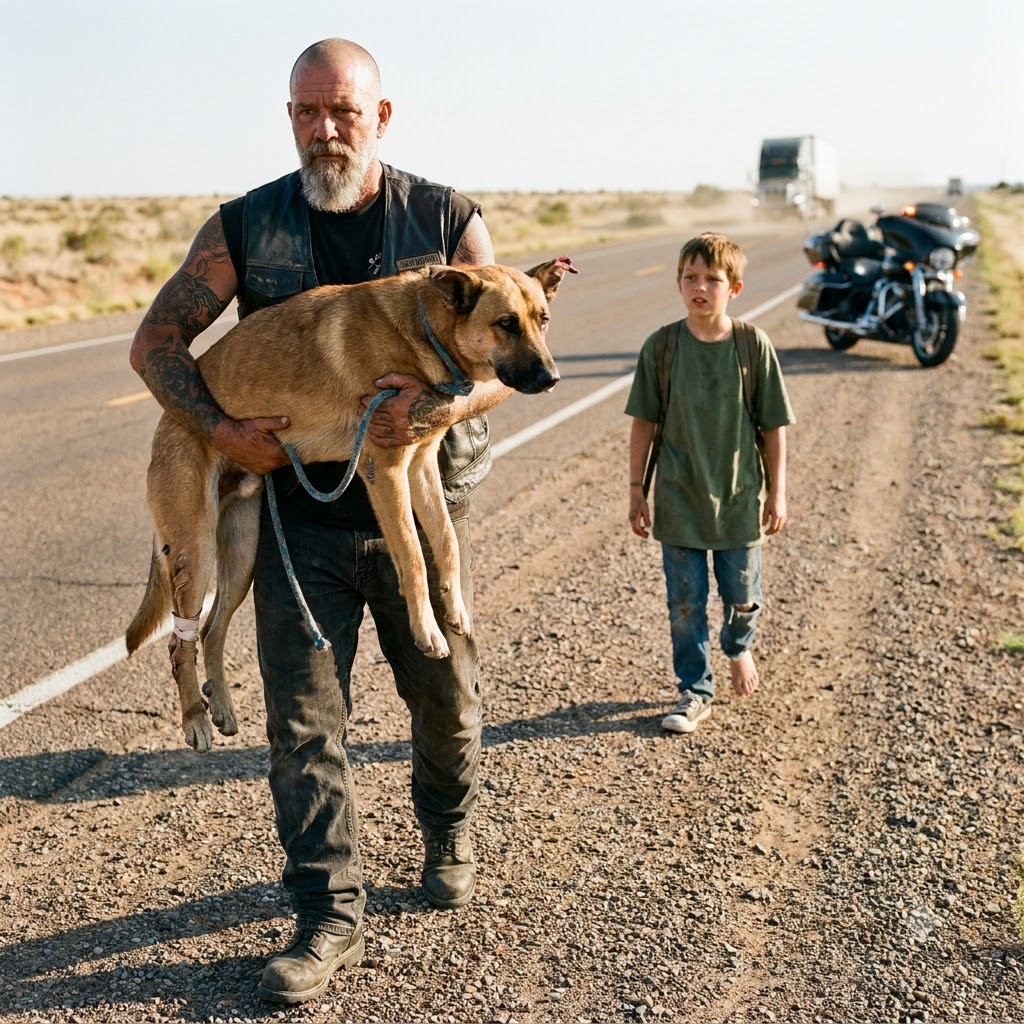
My name is Mason Hale, but in the Black River Saints, I am Graves.
The nickname did not come from burying people, despite what Lily apparently believed. I spent twenty-seven years engraving names and dates onto granite memorials before a damaged shoulder forced me into fabrication work.
Graves was short for gravestones.
Children, however, judge men by simpler evidence.
I was the biggest person in the room. I had tattoos. I wore leather. Therefore, I must be able to scare away monsters.
Lily’s logic was wrong.
It was also the first sensible plan anyone in her family had managed to attempt.
After Ethan arrived, Deputy Carla Webb met us at the Iron Lantern. She listened to Lily separately, then spoke with Ethan while another deputy reviewed the threatening messages.
Ethan initially minimized everything.
The black eye came from “falling at work.” His taped fingers had been “caught in a cabinet.” The broken porch light was “old wiring.”
Lily corrected each answer.
“They hit you by the refrigerator.”
“They bent your fingers.”
“The tall one broke the light with his hand.”
Ethan’s face collapsed a little more each time.
Shame makes people defend the story hurting them.
Deputy Webb explained that threatening violence to collect an unlawful debt could be criminal regardless of whether Ethan legitimately owed money. She asked whether he possessed a written contract.
He produced photographs of three pages stored inside his phone.
The document described a twelve-thousand-dollar “private bridge loan,” but the fees changed weekly. Missed payments triggered penalties calculated on the entire balance. The listed company address belonged to an empty storefront.
Ethan had paid more than fourteen thousand dollars already.
According to the collectors, he still owed thirty-five thousand seven hundred.
The numbers were designed never to end.
Our club’s attorney, Naomi Price, arrived carrying a laptop and wearing rain boots beneath a business suit. She had represented several riders in ordinary matters—traffic citations, business contracts and one divorce that made everyone miserable.
She read the loan pages twice.
“This is not enforceable the way they claim.”
Ethan shook his head.
“They don’t care what’s enforceable.”
That was the real problem.
A civil argument would not stop three men arriving at his door that night.
Deputy Webb requested a patrol presence, but officers could not use Lily’s report as permission to set an elaborate trap without coordination. They could monitor the area, take statements and respond if the collectors returned or made threats.
Naomi advised Ethan to send no provocative messages.
I told the club something else.
“No one touches anybody.”
Several riders looked disappointed.
I understood. Men who harm a father in front of his child trigger a certain response. But anger would only give the collectors a defense, endanger Lily and turn us into the people she mistakenly believed she needed.
Tack Moreno asked, “Then why are we going?”
“To witness.”
“Sixteen witnesses?”
“They like crowds when the crowd’s scared.”
Luis Ortega nodded.
“Let’s give them a different crowd.”
Before leaving, I collected every weapon from club members who carried legally. Each went into the Iron Lantern office safe. Phones remained charged and recording settings were prepared, but Naomi warned us not to publish anything involving Lily.
The sheriff’s department received our names, vehicle descriptions and plan.
We rode to Ethan’s house in two groups to avoid surrounding traffic. Rain clicked against my helmet. V-twins rolled low through the neighborhood, loud enough to announce us without anyone twisting throttles for theater.
The Carter house stood on Willow Street near an abandoned textile warehouse. It was a one-story rental with peeling white paint, a plastic slide in the yard and plywood covering the broken porch light.
A kitchen chair still rested beneath the front doorknob.
Ethan removed it before letting us inside.
The house was clean but almost empty. Medical envelopes occupied one end of the table. A child’s medication schedule was attached to the refrigerator with a magnet shaped like a strawberry.
On the mantel sat a broken ceramic pig.
Pink fragments had been gathered into a cereal bowl.
Lily’s life savings remained in my jacket pocket because she refused to take them back.
I asked where her mother was.
Ethan said Lily’s mother had died from an infection when Lily was three. Since then, it had been the two of them.
That fact made some men look away.
We positioned riders in the front yard, driveway and porch. Nobody blocked the sidewalk. Nobody carried bats, chains or guns. The bikes remained parked.
Deputy Webb waited out of direct view because law enforcement wanted to observe the collectors’ behavior without our group provoking contact.
At 7:52, Ethan received a text.
OUTSIDE IN TEN. DON’T MAKE THIS UGLY.
Lily read it over his shoulder.
She looked at me.
“Are you scared?”
“Yes.”
Her expression changed. The scariest man in the bar had admitted fear.
“Then why did you come?”
“Because scared isn’t the same as leaving.”
She nodded as though adding the information to a private rulebook.
At 8:07, the black SUV turned onto Willow Street.
Sixteen bikers stopped talking.
The vehicle slowed.
I could see three silhouettes.
For one long moment, the SUV idled across from the house while rain moved through its headlights.
Then the passenger window lowered.
Part 3
The man in the passenger seat held a phone.
He pointed it toward the house, recording us as we recorded him. His hair was cut short, and a dark jacket covered most of his neck. I could not see a weapon.
Nobody in our yard moved.
The driver rolled forward ten feet and stopped again.
The rear passenger opened his door slightly.
Luis took one step toward the porch rail, not the street.
I said, “Hold.”
He stopped.
That single word may have prevented the entire night from becoming something else.
The passenger shouted Ethan’s name.
Ethan stood behind us near the doorway.
Naomi had instructed him not to negotiate alone. Deputy Webb had instructed us not to interfere with lawful police action. Lily was inside with the bartender’s wife and could not see the road.
Ethan answered, “Police have the messages.”
The passenger laughed.
“You called cops over a loan?”
Naomi spoke from the porch.
“I’m counsel for Mr. Carter. Future contact goes through my office. Your current demand includes unlawful interest and documented threats.”
The passenger aimed his phone at her.
“Who are all these clowns?”
Sixteen grown men absorbed the insult without responding.
That was our brotherhood’s test.
Bikers talk about standing together as though the difficult part is arriving. Sometimes the difficult part is remaining still after you arrive.
The rear door opened another inch.
A sheriff’s cruiser entered from the opposite end of Willow Street. No siren. No dramatic acceleration.
The SUV door closed.
The passenger shouted that Ethan still owed principal, then told the driver to leave. The vehicle continued past the house, turned at the corner and accelerated away.
Deputy Webb followed.
A second unit approached from the other direction and obtained the license plate. Officers did not pursue at dangerous speed because there had been no immediate assault, but the plate and recorded statements provided an investigative lead.
Nobody applauded.
The collectors had left, but they knew Ethan had sought help. That could make him safer—or place him at greater risk later.
Naomi arranged for Ethan and Lily to spend the weekend at an undisclosed hotel funded through the club’s charity account. Deputies added extra patrol checks around the house.
The riders stayed while they packed.
Lily emerged holding a purple suitcase and the cereal bowl containing the broken pig.
“Did you beat them?”
“No.”
“Did they get scared?”
I considered lying.
“They decided not to stop.”
She smiled.
To her, that was close enough.
At the Iron Lantern later that night, Naomi spread the loan documents across the pool table where Lily’s money had been counted.
The origin of the debt emerged slowly.
One year earlier, a pediatric cardiologist identified a congenital defect that had begun affecting Lily’s oxygen levels and stamina. She required a specialized repair at a children’s cardiac center in Nashville.
The insurer initially denied part of the authorization, arguing that a different facility was in network. Lily’s doctors believed delaying the scheduled procedure could increase risk, but it was not classified in a way that forced the insurer to resolve the dispute immediately.
Ethan appealed.
The specialty center required a family payment before proceeding while the remaining financial arrangements were reviewed. The amount was twelve thousand dollars.
Ethan had forty-eight hours.
He applied for hospital assistance, but the decision would take longer than the surgery window. His credit cards were nearly maxed from earlier appointments, travel and missed work.
A coworker gave him a number for a “private emergency lender.”
The lender delivered cash and a cashier’s check the same day.
Lily received surgery.
Her heart improved.
The debt became another kind of illness.
Ethan paid weekly. When he missed one payment after losing overtime hours, the lender added penalties. Each payment appeared to reduce fees rather than principal.
Within eight months, he had paid more than he borrowed and owed almost three times the original amount.
Ethan hid everything from Lily.
He told her the bruises came from work. He said the broken light had been hit by a branch. When men visited, he sent her to the bedroom with headphones.
But children notice the shape of fear.
Lily heard one collector say Friday.
She saw our motorcycles outside the tavern during the bus ride from school. In her mind, big men frightened smaller men. Therefore, the biggest man in the biker bar could fix what police, money and her father could not.
The misunderstanding saved them.
Naomi found several irregularities in the loan. The stated company lacked the required lending license. Fees exceeded legal limits. Signatures had been notarized by someone whose commission had expired.
More importantly, the threats and assaults created a criminal matter separate from any legitimate obligation.
She contacted a prosecutor experienced in financial crimes.
Deputies obtained Ethan’s medical records, payment receipts and threatening messages with his consent. Security cameras from a neighboring house had captured an earlier visit by the SUV.
The investigation widened.
Two additional borrowers came forward after police traced the company name. One was a restaurant worker who had borrowed for funeral expenses. Another was an elderly man who had signed over the title to his truck after a hospital stay.
This was not one aggressive lender.
It was a network built around desperate people who could not wait.
The next week, investigators asked Ethan to participate in controlled communications under police direction. He agreed only after Lily was placed temporarily with her grandmother outside the county.
I told him he did not have to become bait.
He looked at the photograph of Lily after surgery.
“She walked into a biker bar because I was too scared to tell anybody.”
His voice remained quiet.
“I’m done teaching her that.”
The false climax had been the SUV leaving Willow Street.
The real fight would happen through recordings, subpoenas, bank records and courtrooms.
And the forty-three dollars in my pocket had just become the smallest piece of evidence in the largest case our club had ever touched.
Part 4
The Black River Saints had rules about club money.
Charity funds paid documented needs. Nobody used them to erase personal debts without review. Every dollar received two signatures because generosity without records becomes rumor quickly.
Some members wanted to pay the full thirty-five thousand seven hundred and end the danger.
Naomi stopped them.
“Paying an unlawful demand rewards the threat and destroys leverage.”
Others wanted to visit the lender’s office.
I stopped them.
“No.”
Tack argued that standing in a yard had worked.
“It worked because we didn’t do anything.”
He disliked that answer, but he understood it.
Our role became less visible. We drove Ethan to meetings, paid for temporary lodging and watched Lily after school while he met investigators.
We did not threaten anyone.
That restraint mattered when the lender’s attorney later tried to portray the club as an extortion group pressuring a lawful business.
Every police report documented our cooperation. Every video showed riders remaining on private property. Our firearms had been secured before the collectors arrived.
The defense found no fight to use.
Investigators identified the lender as Ridgeway Emergency Holdings, a shell company connected to two brothers and several associates. It operated through word-of-mouth referrals, targeting people facing medical bills, funerals, rent crises and immigration expenses.
Borrowers signed confusing contracts.
When they fell behind, “field representatives” appeared.
The three men visiting Ethan were not licensed collection agents. Two had assault records. The third worked for a towing company partially owned by one Ridgeway brother.
Bank records showed dozens of borrowers making weekly payments.
Several had paid more than twice their principal while balances continued rising.
The prosecutor did not build the case from our outrage. She built it from documents, witnesses and recorded threats.
Ethan’s cooperation helped obtain them.
During one controlled phone call, a collector said Lily’s surgery would “feel cheap” compared with what happened if Ethan kept avoiding payment.
Ethan’s hands shook so badly he nearly dropped the phone.
Deputy Webb ended the call.
That threat changed the investigation’s urgency.
Search warrants were executed at Ridgeway’s office and two residences. Officers recovered contracts, payment ledgers, unregistered firearms and photographs of borrowers’ homes.
One photograph showed Lily’s school bus stop.
When Ethan saw it, he vomited into a courthouse trash can.
I had believed our presence on Friday protected the family.
The photograph proved the danger had followed Lily long before she entered the bar.
Police arrested five people. The three men in the SUV were charged in connection with threats, assault and unlawful collection activity. The broader financial case involved unlicensed lending, extortion and conspiracy allegations.
Arrests did not settle Ethan’s debt automatically.
The civil contract still required review.
Ridgeway argued that Ethan had voluntarily accepted twelve thousand dollars and therefore owed principal plus permissible costs. Naomi agreed he owed the legitimate principal balance after credit for payments.
The accounting changed everything.
Ethan had borrowed twelve thousand.
He had already paid fourteen thousand six hundred.
Under a lawful calculation, he might have owed nothing.
But payment records were incomplete, and several cash installments lacked receipts. Rather than pretend certainty, Naomi negotiated while a civil action proceeded.
The court ultimately declared the excessive interest and penalty terms unenforceable. Documented payments were credited against principal. A disputed balance of several thousand remained during reconciliation.
The club offered to cover whatever lawful principal the final accounting established.
Ethan refused.
“You already did enough.”
Luis pointed to the broken pig on the bar shelf.
“Your kid hired us.”
“That was forty-three dollars.”
“Best retainer we ever got.”
The criminal case drew local attention. Reporters learned how Lily had entered the Iron Lantern. Some wanted to photograph her beside sixteen bikers.
Ethan declined.
Lily was a child, not a mascot.
We agreed.
The club released no photographs showing her face. I gave one statement through Naomi:
“A child asked for violence because adults had failed to give her safer words. We chose witnesses, police and a lawyer.”
That line made people assume I had become wise.
I had not.
I had simply spent enough years making mistakes to recognize one before it happened.
The hidden twist was not only that Lily wanted protection instead of revenge. It was not even that the debt had paid for her heart surgery.
It was that Ethan’s decision to save his daughter had trapped him inside a machine built to punish urgent love.
He had borrowed because a medical clock moved faster than financial mercy.
The Ridgeway case exposed eighteen borrowers in similar situations. Restitution and debt relief proceedings began.
One borrower asked why a biker club had become involved.
I held up Lily’s bag of money.
“Professional fee.”
The room laughed.
Lily did not.
She asked whether the bad men could return.
I told her the truth.
“They might get out someday.”
Her face tightened.
“But police know them now. Your dad has a lawyer. And you know how to ask for help.”
She looked toward the club.
“I already knew.”
That answer landed harder than anything in court.
Part 5
The criminal case took fourteen months.
During that time, Ethan rebuilt his life in ordinary pieces.
He changed rental houses, accepted a maintenance job at a school district and worked with a nonprofit financial counselor. Lily continued cardiology follow-ups. Her repair remained successful, though she tired faster than classmates during running games.
Our club stayed involved without moving into their lives.
That boundary mattered.
Protection can become control if the protector never learns to leave.
Lily visited the Iron Lantern only during daytime family events after the bar area was closed. She learned to play pool using a shortened cue. She defeated Tack twice because he scratched the cue ball whenever people watched.
Ethan sat nearby.
At first, he watched every door.
Months passed before he stopped.
The civil accounting concluded that, after all documented payments were credited and unlawful charges removed, Ethan owed no additional interest. A small remaining principal amount could not be verified because Ridgeway had failed to maintain lawful records.
The court ruled it unenforceable.
Ethan’s debt was gone.
The club had already raised twelve thousand dollars—the original principal—before that ruling. Since Ethan no longer needed it, members voted to create the Lily Carter Emergency Medical Bridge Fund, administered by a local nonprofit rather than the club itself.
The fund helped families facing urgent travel, lodging, medication and appeal-related costs during pediatric treatment.
We did not lend money.
We gave grants.
Naomi insisted on written eligibility standards and independent oversight. She had learned that good intentions require rules too.
The criminal defendants received different outcomes based on their roles. The Ridgeway organizers were convicted on financial and extortion-related charges. Two collectors pleaded guilty and testified. Restitution orders covered multiple victims, though no one expected every dollar to return.
Justice arrived as paperwork, hearings and imperfect numbers.
It did not erase Ethan’s bruises.
It did make the black SUV disappear from Willow Street.
Lily’s forty-three dollars remained unresolved.
I had kept the bag sealed in my shop safe because I did not want anyone treating it as club money. When the case ended, I returned it to her.
She pushed it back.
“The job worked.”
“You hired me to beat somebody.”
“I said it wrong.”
“Contracts care about words.”
She crossed her arms. “You knew what I meant.”
There was no winning.
The club framed the money between two sheets of clear acrylic. We did not glue or damage the bills. The coins rested in a narrow channel beneath them.
Below the frame, Naomi suggested a small brass plate.
Ethan objected to anything glorifying the confrontation. We agreed the wording had to honor Lily’s courage without celebrating violence.
The finished plate read:
THE MOST EXPENSIVE CONTRACT EVER SIGNED HERE — $43
The frame hung above the pool table.
Lily inspected it.
“You spelled everything right?”
Naomi assured her we had.
“Then okay.”
The broken ceramic pig sat on a shelf in Ethan’s new kitchen, repaired with visible gold-colored seams by one of the riders’ wives. Lily could have received a new piggy bank, but she wanted the broken one.
“It remembers,” she said.
That phrase followed me.
The money remembered a child walking through rain.
The pig remembered what she sacrificed.
The scar beneath her collar remembered why her father borrowed.
My club remembered that sixteen large men had been most useful when they refused to swing a single fist.
The biggest change happened inside Ethan.
For months, he believed Lily would blame herself if she learned the truth. A family therapist helped him explain the debt without placing adult responsibility on her.
He told Lily the surgery cost money, insurance delayed payment and he made a desperate choice.
Lily asked whether he borrowed because of her.
“Yes,” Ethan said.
She began crying.
He held her and added the sentence he should have spoken earlier.
“That was my decision. Your heart did not do anything wrong.”
Lily pressed one palm over the scar on her chest.
“Did it make the bad men come?”
“No. Their choices did.”
She accepted the answer slowly.
Children do not heal from one perfect conversation. She asked the same question in different ways for months.
Each time, Ethan answered.
The club paid for therapy through the medical bridge fund’s separate family-support program. Ethan initially refused that too, until Lily told him Graves said scared was not the same as leaving.
He attended.
On the first anniversary of the night at Willow Street, Ethan brought Lily to the Iron Lantern’s family cookout.
She placed a new sandwich bag on the pool table.
Inside were forty-three paper hearts cut from red construction paper.
One for every dollar.
On each heart, she had written a name: police officers, attorneys, riders, nurses, teachers and neighbors who helped after the story became known.
One heart remained blank.
She handed it to Ethan.
“That one’s yours.”
He turned away because he did not want sixteen bikers watching him cry.
Nobody looked directly at him.
Brotherhood sometimes means giving a man somewhere private while standing in the same room.
Part 6
The framed forty-three dollars became part of the Iron Lantern, but we never told visitors Lily’s full name.
People asked about the sign.
The bartender answered, “A kid once hired the right help with the wrong sentence.”
That was enough.
The medical bridge fund supported nine families during its first year. None received cash from bikers in a parking lot. Hospitals and nonprofit coordinators verified each need, then paid approved expenses directly.
Naomi demanded audits.
Tack called her heartless.
She replied, “This is how it survives after your feelings move on.”
She was right.
Ethan eventually joined the fund’s advisory committee. He spoke with parents waiting on insurance appeals and told them what desperation had made him overlook.
He never pretended every emergency loan was criminal. He taught them to verify licensing, seek hospital assistance and bring contracts to legal-aid offices before signing.
Lily contributed a different service.
She decorated envelopes.
Every family receiving help found a small red heart inside with the words, YOUR HEART DID NOTHING WRONG.
No surname appeared.
The collectors’ black SUV was eventually seized during forfeiture proceedings. Someone joked that the club should buy it.
I said no.
We had enough relics.
On Fridays, Lily attended an after-school art program. The Iron Lantern was no longer on her walking route, but Ethan kept a location-sharing device in her backpack with her agreement.
She understood why.
One rainy evening, she entered the tavern with Ethan and placed a single quarter on the pool table.
“I have another job.”
Sixteen men looked up.
Ethan groaned.
I asked what she wanted.
“The library needs shelves.”
Luis smiled.
“What’s the quarter for?”
“Deposit.”
The club built the shelves the following weekend, under the supervision of a librarian who rejected our first measurements and made us start again.
Lily watched from a chair.
When the final shelf stood level, she examined it, nodded and told the librarian, “They’re scary, but they follow directions.”
Nobody corrected her.
Part 7
Lily is twelve now.
Her cardiologist says her heart is strong. She swims, draws and avoids running unless someone is chasing her with cake.
Ethan no longer checks the window every time headlights slow outside. He still keeps Naomi’s number near the refrigerator, along with Deputy Webb’s card and the emergency fund information he now gives other parents.
The Ridgeway network is gone.
Other predatory lenders remain. So do insurance disputes, medical bills and families forced to make decisions faster than help arrives.
The fund cannot fix all of that.
It can open one more door.
The forty-three dollars still hang above the Iron Lantern’s pool table. The one-dollar bills are wrinkled. The coins have darkened slightly around the edges.
Beneath them, the brass plate catches the light.
Visitors assume the “most expensive contract” refers to money.
It does not.
The cost was an eight-year-old learning that her father could be hurt. It was Ethan believing his daughter’s life had created a debt he must carry alone. It was sixteen men holding their anger in a front yard because violence would have made the danger worse.
Lily once asked whether I would really have beaten someone for forty-three dollars.
“No.”
“Even if they were bad?”
“No.”
She considered that.
“Then why did you take the job?”
I looked toward her father.
“Because you didn’t need somebody to hit back.”
“What did I need?”
“Adults who stayed.”
She accepted that answer.
On every anniversary, Lily brings forty-three paper hearts to the bar. Some go to the medical bridge fund. Some go to nurses at the children’s cardiac center. One stays beneath the framed money.
The handwriting changes as she grows.
The message does not.
YOUR HEART DID NOTHING WRONG.
Follow our page for more powerful biker stories about misunderstood requests, quiet protection and the rough-looking strangers who choose restraint when a child needs safety. The strongest men stayed still.